
Although we did our best to call attention to these points, in all the excitement it is not uncommon for a few crumbs of information to get lost!
The entire treatment is built on moving the teeth. Unfortunately, the teeth are not too happy about this, and so until they get used to their new nomadic life, they voice their displeasure with pain. During the first 5-15 days it is completely normal for some teeth, or even all of them, to ache. Sadly there is nothing to be done about this; it will only improve with time. Of course, if the pain becomes too uncomfortable, you may take 1-2 painkiller tablets to relieve it.
Another part of the initial difficulties is irritation of the lips and the inner side of the cheeks! Until now the teeth were smooth and nothing could catch on them, but that has now changed. The muscles adapt quickly, but many people need the wax we gave you at the bonding appointment during the first few days. It is best to pinch off small pieces of the wax, warm them between your fingers, and press them onto the particular bracket that is sharp or that is rubbing the lip. This rounds it off and gives the mucous membrane a chance to heal.
Not everyone gets a bite raiser, but those who do will not be able to chew properly during the first few weeks. This improves over time and becomes less and less bothersome, but like the points above: this too must be endured.
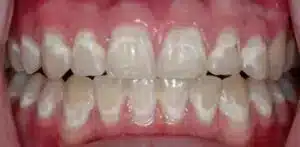
We hope brushing has been an inseparable part of your daily routine until now, but with the brackets now on your teeth it becomes even more important! Since the teeth no longer consist of just one nice smooth surface but now have a bracket in the middle, every bit of food residue will try to cling on there. This is partly unsightly and partly harmful, since, as everyone knows, the plaque left on teeth is what causes tooth decay. The plaque that collects around the corners of the orthodontic appliance produces a characteristic pattern of decay, with window-like white spots on the teeth. Once again: it is not the orthodontic appliance that causes the spots, but the plaque that collects around it. Preventing this is the patient’s responsibility!
Interdental brushes can be a useful aid in this battle! An ordinary toothbrush does not always reach the area under the wire properly, and these tools, designed specifically for the spaces between the teeth, can supplement your toothbrush. They are available in various sizes at every drugstore; it is worth choosing the right one and always keeping one in your toiletry bag!
It is also important to point out that you need to be careful with certain foods in the coming period! These include very hard, crunchy foods. Unfortunately these can lead to brackets breaking off or the wire becoming deformed when you bite down on them. Any such damage extends the length of the treatment somewhat, so it is worth paying attention to this!
Sticky, chewy foods are the other problem group, because they stick to the brackets and only come off with difficulty on their own, posing a serious risk of tooth decay. Caramel-based foods, toffee and the like are especially problematic!
Chewing gum, while not forbidden, calls for caution! Once it gets wound around the appliance, removing it can be quite difficult. It is not banned, but it is not advisable.
It would be extremely important to be careful and to handle the appliance gently, taking care not to break off the brackets when chewing, because if you do manage to break one, it really does extend the treatment significantly, and nobody needs the extra visits to the practice!
Since the orthodontic appliance is working continuously, we can also cause problems by checking on it too rarely, though check-ups that are too frequent do not move things forward either. One of the worst things you can do is to “disappear” for months, because then the appliance works in one direction uncontrolled. In rare cases this can lead to permanent damage to the teeth, so we must emphasize here that keeping to regular check-ups is essential!
🔸What should I do if one of the brackets comes loose or breaks off?
🔸What should I do if the last pad comes loose?
🔸One of my bite raisers fell off, what should I do?
🔸The wire broke, what should I do?
We are happy to help you with anything!

 Types of Braces – Find the One That’s Best for You!
 The Orthodontic Treatment Process Step by Step
 Orthodontics: How to Live in Harmony with Your Braces

 Underbite: More Than Just an Aesthetic Concern

