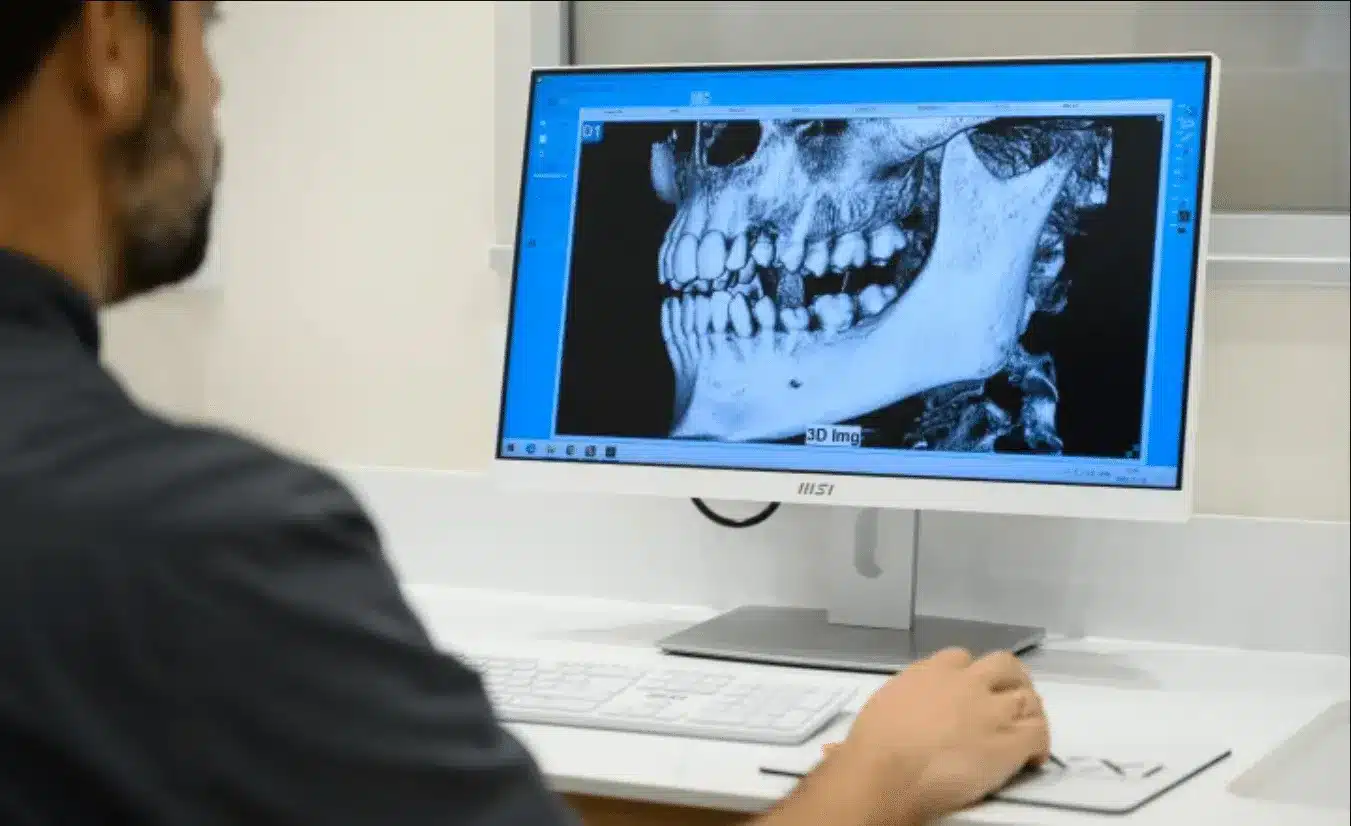
Dr. Pulay Zoltán orthodontic specialist surgical consultation előtt

Surgical Orthodontics

When harmony is born from complex cases

There are severe jaw and bite irregularities whose correction can no longer be achieved by tooth movement alone. Surgical orthodontics is the field where the cutting edge of surgery and orthodontics meet — so that we can restore perfect function and harmonious facial aesthetics even in the most complex situations. This is not just an intervention, but a transformation that changes lives!
Surgical orthodontics specialists at the Foxxi Buda Orthodontic Clinic

What is surgical orthodontics?

We talk about orthodontics combined with jaw surgery when the orthodontic problem is not just that the teeth are in poor or unattractive positions, but the jaws themselves are deformed, underdeveloped or asymmetric in some way. In such cases orthodontic treatment is supplemented by usually one, sometimes two, larger surgical interventions. These are called orthognathic surgeries, or jaw surgeries. Cases combined with surgery take longer due to their complexity, and require greater care than traditional orthodontic treatments. However, the results are also far more spectacular — we can often achieve life-changing aesthetic transformation and functional improvement.
A surgical orthodontics tervezése digitalan zajlik és több szakértő bevonását vesszük igánybe

Surgical solutions: types of orthognathic surgery

The goal of orthognathic surgeries is to set the position or size of the jaws relative to the rest of the skull.
  • Lower jaw surgery (Sagittal Split Osteotomy): The most common type of surgery, allowing the lower jaw to be moved forward, backward or sideways into the desired position.
  • Upper jaw surgery (Le Fort I Osteotomy): With this intervention the upper jaw can be moved forward or backward, raised (to correct a gummy smile) or lowered (to close an open bite).
Digital planning is essential for planning jaw surgeries
  • Bimaxillary surgery (Bimaxillary Osteotomy): When the problem is so complex that a perfect result requires correction of both jaws.
  • Minimally invasive, surgically assisted upper jaw expansion (SARME): in adulthood, traditional orthodontics is no longer sufficient for effective expansion of the upper arch. We use this procedure to create space in cases of crowded teeth or crossbite.
  • Genioplasty / Chin surgery: Often as a complement to the above surgeries, by fine-tuning the position of the chin we create the perfect facial aesthetics and profile.

Some examples of jaw issues correctable with surgery

In a Class II profile (bird face) the size of the lower jaw lags behind the upper — the receded chin and its correction are clearly visible in the picture

Class II profile (bird face)

In this case the size of the lower jaw lags significantly behind the upper, resulting in a characteristic profile with a receded chin, often combined with aesthetically and functionally inadequate dentition.
Bulldogharapás surgical orthodonticssal

Class III profile (underbite)

The growth of the lower jaw significantly exceeds that of the upper, so a pronounced jawline and protruding chin is characteristic — often combined with aesthetically and functionally inadequate dentition.
zárt fogsor látható keresztharapásban

Narrow upper jaw

A characteristic of this discrepancy is obstructed nasal breathing, which usually becomes completely habitual over the years, but causes serious long-term consequences. Up to about age 16 a narrow upper jaw can be treated without surgery, but after that — at an increasing rate with age — only SARME, surgically assisted rapid maxillary expansion, can solve the problem.
Asymmetric facial bone deviation, often corrected with jaw surgery

Arc aszimmetria

One side of the face grows slightly larger than the other, possibly developing incorrectly due to a childhood accident. With small differences this only causes wear or crowding at the level of the teeth, but a larger discrepancy can already be visible on the face. Often the upper dental arch is tilted compared to the plane of the eyes, perhaps the lip is too, and the chin is not in the midline of the face.
Az ínymosoly korrekciója surgical orthodonticssal

Gummy smile

A positional irregularity of the upper jaw, where the upper dental arch is not in the smile line but significantly lower, so that a wide band of gum is visible above the teeth when smiling.
Hasadékos patientek surgical orthodonticsa

Cleft lip and palate

The most common facial developmental anomaly is cleft lip, jaw and palate, affecting a large number of newborns worldwide. Care for those born with a cleft begins within just a few days of birth and generally lasts into young adulthood. As part of this, long-term orthodontics and a series of surgeries are needed. Infant and early-childhood care for cleft patients is a clinical, hospital task. From around age 7, that part of the treatment begins which — although still free of charge for the insured under public-health support — can also be carried out within private care. Most patients suffer from the disadvantages of both a narrow upper jaw and an underbite at the same time, and addressing these requires long treatment but brings lasting, very spectacular changes.

The course of orthodontics combined with jaw surgery

Consultation and planning
Based on the initial diagnostics — X-rays, digital impression, photos — we plan the course of treatment. If the surgeon who will eventually carry out the operation agrees with the treatment plan and accepts the surgery, we begin the orthodontic preparation.
Pre-surgical orthodontics (approx. 12–18 months)
The orthodontic process is very similar to non-surgical treatments, but documentation is prepared more often. With fixed braces or Invisalign aligners we "straighten" the dental arches so that we can establish a perfect bite after surgery.
Jaw surgery
Most interventions involve a 1–4 hour surgery under general anaesthesia, with a 1–2 day post-operative hospital stay. All incisions are made inside the mouth, so there are no external scars. The exact procedure depends on the case complexity, but in general both upper and lower jaws can be repositioned to achieve the planned harmonious bite and facial aesthetics.
Post-surgical orthodontics (approx. 6 months)
After surgery the orthodontic appliance is still in place, so that we can fine-tune the upper and lower arches. At the end of treatment, after the appliance is removed, retention devices ensure the lifelong preservation of the achieved result.
Dr. Magyar Dominika Orthodontic specialist és Dr. Pulay Zoltán Orthodontic specialist

Why choose us? – This is our specialty

The main specialty of our clinic is the orthodontic treatment of severe, complex cases involving jaw and bite irregularities. At the Foxxi clinic we perform the orthodontic part of orthognathic surgical treatments in large case numbers. We are particularly proud that colleagues from across the country refer their patients to us with the most complex cases, trusting in our successful results. Our clinic works with one of the most renowned head, neck and oral surgeons of Budapest, Dr. Krisztián Nagy, and his team. Our years-long close cooperation means that we regularly perform orthodontic treatments combined with surgery in large numbers. The mature, well-functioning communication between the surgical and orthodontic sides means a smooth, predictable patient journey for our patients.

Considering orthodontics combined with surgery? Let us discuss your options!

Frequently asked questions about surgical orthodontics

Is surgical orthodontics painful?

The surgery itself takes place under general anaesthesia, so you do not feel pain during it. We provide pain relief in the post-operative period, but in general it can be said it is less unpleasant than wisdom-tooth removal.

How long does recovery from orthognathic surgery take?

Recovery time after surgery is generally 2–3 weeks. The first week is mainly about rest and wound healing. Swelling decreases gradually over 7–10 days, and sutures are removed after about a week. Heavy physical work is not recommended for 3 weeks, contact sports where the face could be hit for about 3 months.  

What can I do to speed up recovery?

Rest is important, as is a soft diet, increased oral hygiene, and attending check-ups. Avoid physical strain and hard foods in the first weeks. By following the recommended instructions, recovery will be faster and safer.

Will there be visible scars?

During orthognathic surgeries the incisions are placed inside the mouth, so external scars are not visible. The internal scars heal nicely within a few weeks and are unnoticeable to most patients.

How much does surgical orthodontics cost?

The price is always individual, since everyone arrives with a different starting situation. We can give the exact orthodontic costs after the diagnostic examination. At our clinic you always receive a transparent quote, so there is no need to fear hidden costs. The cost of the surgery will be determined by the surgeon during the surgical consultation.

How long does the entire surgical orthodontics process take?

Orthodontics combined with surgery is generally not much longer than normal orthodontics. On average, a treatment time of 1–2.5 years should be expected, depending on the complexity of the task. The process consists of several steps. After orthodontic diagnostics and surgical examination, a treatment plan is created — based on this, orthodontics begins. We prepare the dental arches for surgery, then after the surgery we continue tooth alignment and fine-tuning of the bite.

Who performs the surgery, and where does it take place?

The surgical part is performed by our experienced head, neck and oral surgeon colleague, Dr. Krisztián Nagy, and his team in modern hospital conditions. Orthodontic planning and the management of the entire treatment takes place at our clinic Foxxi, in close cooperation with the surgical team.

What types of jaw surgery exist, and what are they used for?

We use various types of jaw surgeries to complement orthodontic treatments — the precise choice always depends on the individual. SARME is used for upper jaw expansion if the palate is narrow or there is a crossbite. Le Fort I surgery enables full repositioning of the upper jaw forward, backward or downward, harmonising the bite and facial proportions. BSSO (Bilateral Sagittal Split Osteotomy) means bilateral splitting of the lower jaw, allowing us to move the mandible — i.e. the lower jaw — forward or backward. bimaxillary surgery means surgically correcting both jaws, so that complex bite problems and facial aesthetic needs can also be addressed. Before every surgery, thorough diagnostics and planning take place, so that the treatment delivers the best possible result.

What are the benefits of surgical orthodontics?

Orthodontics combined with jaw surgery brings both functional and aesthetic improvement at once. The bite is restored, chewing becomes more efficient, the load on the teeth and the jaw joint decreases. Expansion of the upper jaw can improve breathing, and orthognathic surgeries result in a more harmonious facial profile and a more beautiful smile.

Is wisdom-tooth removal needed before surgical orthodontics?

Generally yes — in most cases the wisdom teeth need to be removed before orthognathic surgery. The reason is that during the surgery we cut and reposition the jaws, and wisdom teeth in the back region can hinder safe surgical access or increase the risk of complications. We usually recommend removal months before the surgery, so that the bone and soft tissues fully heal. There are rare situations where a wisdom tooth can be left in, but this is always decided jointly by the surgeon and the orthodontist.